
Rise Above It: Staying Grounded In An Escalation-Happy World

Two arguing children stick their tongues out at one another.Gather ’round, workers of the world.  Today I am voicing my exasperation with behavior that has lately been chapping my hide: superfluous escalations. Corporate America is stinking with them

Don’t get me wrong, escalation can be warranted, like when a project team has tried every avenue of negotiation and bargaining to resolve a difference of opinion but has reached an impasse.  Raising the discussion up to more senior leadership can break the logjam.

On other (rare) occasions, when a rogue colleague is having a toxic effect — proving immune to charm, logic, reason, and pleas for civility and partnership — a constructive chat with his/her manager can be a reasonable course of action.

What a pity that many workplace escalations do not resemble either example.  Instead, they are little more than tattling, with some lipstick smeared on to pretty things up.

Such tattling takes many forms, but is usually based on the perception that escalation is the surest path to “yes”.  Hoping a colleague will take on a particularly nasty task that falls outside his job description?  If you ask him, he could say “no” so why not just head straight to his boss to get buy-in?  It may alienate and disfranchise your colleague, but don’t worry — if he gets huffy you can always escalate!

Sometimes it is less about speed than effort.  You could invite Sally to coffee to iron out your differences, but resolving conflict is so awkward and time-consuming, and a trip to Starbucks is a long walk in those three-inch heels of yours.  Meanwhile, Sally’s boss’s email address is so handy…

Tattling-type escalations are part of a zero sum game.  They are not meant to reach a mutually beneficial agreement, and move things forward, but to score a “win” by excluding the opposing party from the conversation.

Over the course of my career, I’ve determined that organizations where escalations run rampant have one thing in common: manager overreaction.

Humans are hardwired to find the path of least resistance, and keep to it – like lab rats that memorize the quickest route through a maze to reach the Velveeta.  Likewise with managers who fail to react thoughtfully to escalations.  They set a precedent, and reward the behavior until it is pervasive.

A few years ago, a colleague complained that a member of my team, P., was stepping on her toes on a project.  She was frustrated, and wanted me to set P. straight.  “Have you shared your concerns with her?” I asked.

Clearly this was not the response my colleague was anticipating.  “No I didn’t tell HER.  I’m telling YOU!  You are her MANAGER.”

I didn’t bite.  I suggested that the two at least try to work out their differences without my intervention.  And guess what?  I never heard another complaint.  They may have butted heads from time to time, but they sorted it out.  The project launched successfully, and the futility of tattling to me as a first resort was established.

In some organizations, consensus is king… at the expense of constructive conflict, which is a natural byproduct of workplace diversity, innovative thinking and healthy debate.  Fear of escalation can become punitive, so workers go into self-preservation mode by playing it safe.

What do you think, workers of the world?  Do you agree that workplace escalations are on the rise?  If so, what’s causing it?  How can organizations better encourage professional adults to collaborate and negotiate, rather than tattle?

Your ideas are welcome, no escalation required.

When It Comes To Burning Bridges, It’s Go Big Or Go Home

LinkedIn Cartoon iconLast week, the professional social network LinkedIn invited its “thought leaders” and other content contributors to write about the best  — most counter-intuitive – mistakes they had ever made.  It was pretty tame stuff, nothing controversial: “My Best Mistake: Nearly Getting Fired”, or “My Best Mistake: Forgetting the Five-Year Career Plan”.

On Thursday, however, a LinkedIn user made his own big mistake – and something tells me it wasn’t his best. If it was?  Have mercy.

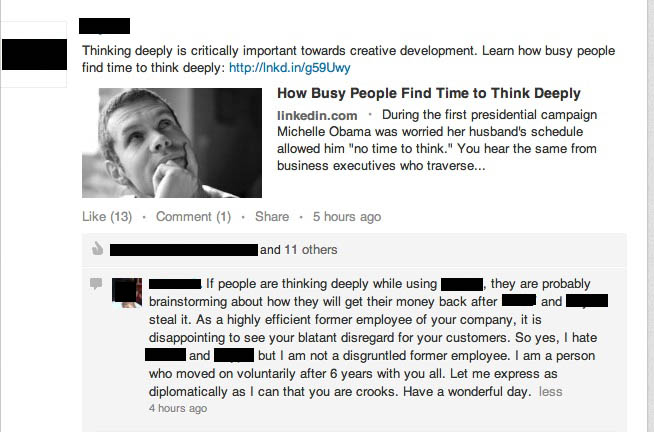
On that day a large, established eCommerce/payments company posted a story, as firms and individuals on LinkedIn often do, titled “How Busy People Find Time to Think Deeply”.   Again, innocuous stuff.  Most of us are busy, and who among us wouldn’t appreciate more time to think deeply, right?

It was in response to this article that a former employee inexplicably chose to air grievances with the firm.  I’ve omitted a few specifics to protect the clueless:

“If people are thinking deeply while using (company’s product), they are probably brainstorming about how they will get their money back after (company and its parent) steal it. As a highly efficient former employee of your company, it is disappointing to see your blatant disregard for your customers. So yes, I hate (you, company) but I am not a disgruntled former employee. I am a person who moved on voluntarily after 6 years with you all. Let me express as diplomatically as I can that you are crooks. Have a wonderful day.”

Completely floored, I sent the link to friends, encouraging them to click on it only if they weren’t squeamish about professional suicide. None of us could conceive of why someone would be so hell-bent on offending both his previous employer AND anyone else who might possibly think of hiring him.  What was he trying to accomplish?

Would you make an offer to someone who holds such consuming grudges, and voices them so recklessly?  Someone who might leave your employ, then paint you as dishonest on social media?

What drives folks to self-destruct on social media this way?  I mean, we’ve all heard stories of knuckleheads who call in sick, then tweet photos of themselves doing keg stands on the beach.  Or who unload on their toady bosses on Facebook, and are summarily fired.  Still, I think this one takes the cake.

If not him, then maybe the unimaginative guy who piled on with, effectively, “Yeah, what he said”.  In the words of Forrest Gump…Stupid is as stupid does.

Aside from the obvious sarcasm in his “have a wonderful day” sign off, you’ve got to love that this guy doesn’t consider himself a disgruntled former employee.  Really?  If his bridge-burning behavior doesn’t scream “disgruntled”, I don’t know what does.  Plus, I think he protests that he left the company voluntarily just a smidge too emphatically.  I’m just not buying it.

Here’s hoping the poor fellow has some friends who can appeal to his better judgment – assuming he possesses any – and convince him to remove the comment.  It had to feel GREAT to blast his old bosses this way, but by now he has probably received quite a few concerned emails asking if he has completely lost his mind.

My Dad once told me a story of a colleague who, many years ago, got drunk at the office Christmas party and told off his bosses.  Within a week, he was transferred to someplace like North Dakota.  In the dead of winter.

Going out in a blaze of glory can sound cool, but pack your suitcase wisely… exile can be a cold place.

Have any good bridge-burning stories?  Share ‘em if you’ve got ‘em.

LinkedIn comment: If people are thinking deeply while using (company’s product), they are probably brainstorming about how they will get their money back after (company and its parent) steal it. As a highly efficient former employee of your company, it is disappointing to see your blatant disregard for your customers. So yes, I hate (you, company) but I am not a disgruntled former employee. I am a person who moved on voluntarily after 6 years with you all. Let me express as diplomatically as I can that you are crooks. Have a wonderful day.

I Am What IM

Up to this point, I have avoided blogging about work because office satire can ruffle feathers.  And… I really like getting paid.   But I suppose there’s no harm in mocking something work-related that is in no way unique to my firm.  It is prolific in Corporate America.  It is instant messaging, and it is devouring our souls.

For anyone who has not encountered instant messaging on a corporate network, allow me to paint you a picture.  IM allows any colleague to draw a bead on you, at any time.  For example, a little radio button will appear next to your name in the “to” field of emails: pink if you are offline, yellow if you’re away from your desk or red if you’re in a meeting.  Creepy, right?  And in my workplace, as in many others I’m sure, instant messaging capabilities are the default.  There is no opting out.

If you are online, colleagues can send you instant messages that pop up at the bottom of your computer screen while you are working, regardless of the program you are working in.  This is generally considered a convenience, although I suspect only the person sending the IM would characterize it that way — not the recipient.

Because corporate IMing is still fairly new, it’s kind of the Wild West out there in terms of etiquette.  Many IM exchanges begin with a polite “hi”, a pardon-the-interruption acknowledgment that the recipient might be otherwise occupied.  Unfortunately, this is usually where courtesy ends.

I work for a bicoastal company so I spend an inordinate amount of time meeting by phone, and I am constantly IM’d when I’m in “red” status.  I consider this rude.  In other words, “I know you are already on the phone, so you won’t pick up if I call you.  And you may not see an email arrive in your inbox.  But I don’t feel like waiting because my needs are so important.  So I choose to interrupt you.”

What’s worse?  When fellow attendees on a conference call IM me while someone else is speaking.  “I joined late, did he talk about X yet?”  “Who is that speaking? I don’t recognize the voice.”  “Joe is such a name-dropping jerk!”  Pretty soon I completely lose track of the discussion at hand, and just have to cross my fingers that the meeting minutes will fill in the gaps.

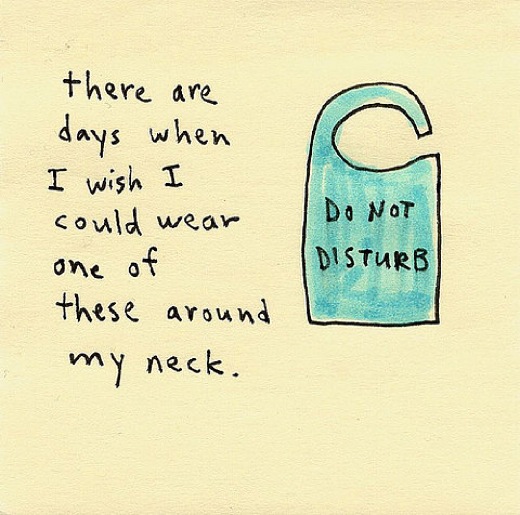
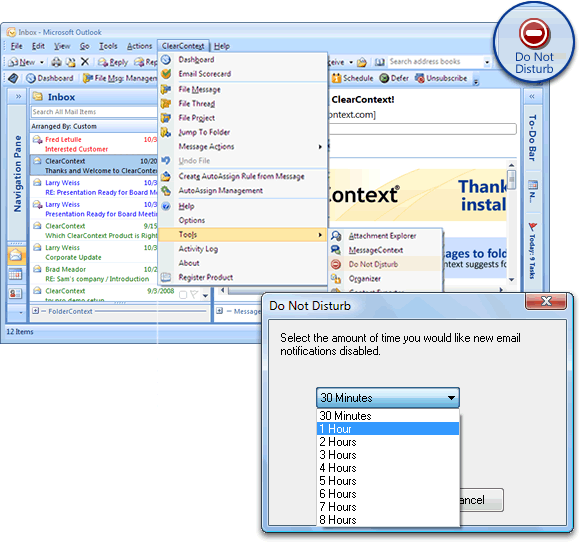
This week I finally employed the last line of defense against abrupt IM intrusion:  the impenetrable “do not disturb” status.   That little button is now my best friend at work.

Don’t get me wrong.  Instant messaging can be valuable.  Some people even use it to power the office grapevine… but I wouldn’t know anything about that.

Any die-hard IM users out there?  Misery loves company, so send me your best corporate IM stories.