Turn On. Tune In. Hit Play.

I am not a slave to television.  I do not plan my life based on the TV schedule… but having a DVR may have something to do with that.  With it I can extend my multitasking even to television watching, and thereby avoid tough trade offs like which baseball game to watch on a given day.  Line ‘em up; I’ll watch them all!

A friend and I recently compared notes on TV shows that horrify us – but that we surreptitiously watch anyway.  We cannot look away.  Of course, I would never, ever record any of these shows because that would be sad and wrong.  But if I were channel surfing and happened to come across one of these…

Hoarding: Buried Alive.  For a neatnik like me, this show is scarier than any death drop roller coaster out there.  The unfortunate hoarders profiled tend to be lonely and isolated, and many just seem bat-shit crazy.   The presence of cameras is usually precipitated by some catastrophic event, like a child has developed asthma due to conditions in the home, and the authorities are now threatening removal and/or to condemn the property.
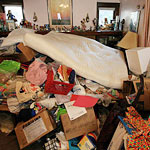
It’s always amazing to me that hoarders are so deathly attached to their stuff.  (Queue sound of hand-slapping-forehead here.)  I know I know, hoarders gonna hoard.  But it’s like someone with emphysema, who needs an oxygen tank to breath, but still refuses to give up smoking.  So… your kitchen sink is clogged and filled with filthy stagnant water.  Your fridge is crawling with cockroaches.  And you sleep on a funked-up mattress next to a mountain of QVC Christmas ornaments that will smother you in your sleep if they fall on you.  Yet, you insist that nothing is wrong?

Will Mary Jo let the biohazard team clean out her house, or will she lose her marbles and lock herself in her basement with her collection of newspapers dating back to the Eisenhower administration?  Those are the scenes that really get my adrenaline pumping!

What Not To Wear.  OK, I lied.  I have been known to record this one, because really… what’s not to love, starting with Clinton Kelly?  (Or as his makeovers from New Jersey often refer to him, “Cli-hun”.)  I highly recommend his book Freakin’ Fabulous: How to Dress, Speak, Behave, Eat, Drink, Entertain, Decorate, and Generally Be Better Than Everyone Else.

The show can be inspiring when a hard-working single mom finally sees herself as beautiful.  But the real guilty pleasure part of WNTW is the clothing choices that got these women nominated for the show in the first place.  “You wore THAT to your husband’s boss’s wedding?  Afterwards he was FIRED, right?”

No matter what fashion faux pas is committed, you’ll find a plus-sized woman shopping in the junior’s department at its core.

The make-up segment is almost always benign.  When there’s a professional make-up artist at work, there’s nothing but upside.  But the hairstyle segment?  Yikes, hang on to your extensions people!   A 55 year-old woman with a middle part and no bangs, two-inch roots and only five hairs on her entire head that aren’t split will plop down in the stylist’s chair and say, “You can do whatever you want, but I want to keep it long.”  The stylist will explain that her cut is a bit “dated” and it ages her, so he wants to cut off FOUR INCHES.  This will leave her with hair only down to (gasp!) her shoulders.  The hair segment usually ends in tears, and a mediation team must be called in.

At the end of the show, the makeover unveils her new look at a cocktail party for family and friends.  Her boss announces that she can use the front door when entering the office from now on.  Her husband is speechless and gives her a big, sloppy smooch.  Her kids cry, and say they have never seen her look so pretty.  (That’s the part that always gets to me.)

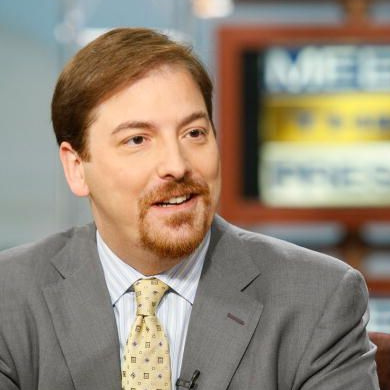
Decision 2012.  This is the guilty TV pleasure that cracked up my friend Jenni, once I assured her that I wasn’t being sarcastic.  I am a registered Democrat who watches the Republic primary debates (sometimes twice!) and takes notes in case something happens worth blogging about.  I also watched the Super Tuesday results come in with my guy Chuck Todd.  He is adorable and objective, and he doesn’t yell or interrupt. (That’s right, I’m looking at YOU Chris Matthews!)  And he can do math really fast.  IN HIS HEAD!
I do not consider Who Do You Think You Are? a guilty pleasure.  There’s nothing to feel guilty about – it’s educational, damn it!  My devotion to it stems from my love of history, genealogy and Ancestry.com… and my determination to prove that I am related to a really good U.S. President.  Not a Warren G. Harding or William Henry Harrison.   I want a founding father, Honest Abe or some sort of Roosevelt (even Eleanor!).

Once I uncover my link to the White House… consider it blogged!

What are your guilty TV pleasures?
Breaking the Silence

I recently began reading the book Quiet, The Power of Introverts In a World That Can’t Stop Talking by Susan Cain.  At last, a book devoted to My People!  With any luck, I can connect with other introverts just by reading it — without ever leaving peace and quiet of my apartment!

It’s true.  I am an introvert – based on Carl Jung’s classic definition of the word.  We introverts can be quite misunderstood, and people who know me often express surprise when I say I am one because I’m not shy, I don’t have a fear of public speaking, and I function reasonably well at social events with people I don’t know.  Yet while I am not the Unabomber, I have indeed tested positive for introversion.

When I first took the Myers-Briggs personality test a few years ago, I was surprised to fall into the introvert category because I am, you might say, slightly outspoken.  When I read the definition, however, it was like so many puzzle pieces falling into place.

Most telling for me was the Jungian/Myers-Briggs belief that when extroverts want to recharge their depleted batteries they go to a bar or throw a party.  They are energized by people and activities, whereas introverts like me prefer to recharge in quiet and solitude.

As Susan Cain describes it, “Introverts may have strong social skills and enjoy parties and business meetings, but after a while they wish they were home in their pajamas.  They prefer to devote their social energies to close friends, colleagues and family… and often feel as if they express themselves better in writing than in conversation.  Many have a horror of small talk, but enjoy deep discussions.”  In other words, Susan Cain just gets me.

A related theory about introverts is that they prefer to socialize one-on-one, or in very small groups.  This also resonates with me.  I have often wondered how I came to establish so many friendships throughout my life… yet my friends generally do not know each other well.   In fact, a number of my longtime friends have never even met.   (I sometimes worry that each friend secretly believes the others are imaginary.)  The last time I had a default “crowd” that I socialized with… I was in college.

Full disclosure:  I have not yet finished the book, and have found myself skimming its more fanciful sections.  (For example, at one point the author suggests that Americans might be more introverted than Europeans through genetics, as immigrants are likely to have been more extroverted and action-oriented than those who stayed put.  Seriously?)  I have, however, enjoyed Susan Cain’s analysis of introversion overall.

That said, my real focus here is on her study of corporate America, and the dominance of extroverts in today’s workplace.  The hair on the back of my neck is standing on end as Cain describes companies where the most assertive and domineering in the room do most of the talking (and very little listening), and are therefore very good at getting their way… even if it’s not the RIGHT way.

All this by Chapter Three — which might as well be titled “Monday”. Welcome to my world.

More on this in my next blog…

Calling Ameriza!

Last spring I did something I’d always vowed I wouldn’t; I got a DVR, and signed up for the overpriced Major League Baseball sports package on cable.  A bit extravagant, but it was worth it to watch my childhood team the Cleveland Indians play five times per week, in addition to my adopted home team the San Francisco Giants.

It’s a hard-knock life when your toughest decision of the day is which baseball game you will watch live, and which you will record.

Unfortunately, my first foray into sports packages was not all sunshine and home runs.  Comcast, er…um… I mean Xfinity, messed up my order — so for the first few weeks I was merely enjoying a free trial without knowing it.  Ah, those were heady, innocent days.  Then, one desperate night in April, I came home to discover… BAM!  NO MLB PACKAGE!

Don’t panic, Xfinity assured me.  We’ll fix it, although it’s too late to give you the early bird discount.  “The System” won’t allow it.

Um, I don’t think so.  I did my best imitation of a wheel in need of serious greasing, and eventually was awarded a credit on my next bill.  Play Ball!

I am puzzled by the billing options with sports packages.  Xfinity, theoretically, allows subscribers to either pay for a sports package in one lump sum, or break it up into monthly payments.   Why on earth would someone choose to pay for the whole thing up front?  Aren’t most folks familiar with the concept of the time value of money?

Of course I say “theoretically”, because when I have requested to pay in installments… things have gone terribly wrong.  In December, when the NBA lockout was resolved, it was time to support my Cleveland Cavaliers by signing up for the NBA sports package.  I asked to pay in monthly installments, but was charged the large lump sum on my first bill.

So it seems that someone at Xfinity, at least, is familiar with the time value of money after all.

It took a frustrating combination of phone calls, online chats and threats through clenched teeth to rectify the situation.  (They threatened to shut off my cable completely.  I vowed to call the The Better Business Bureau, which seemed to tip the scales of customer service in my favor.)

Both my after-hours phone calls, and my online chats, were handled by offshore reps with names like Ameriza or Amerigo.  Hmmm.

I can guess the subliminal message these noms de phone are meant to send. (If you love America, you won’t yell at me?)  And I suspect I will soon have a chance to test out my theory; it’s nearly time to commit to the 2012 MLB sports package.  I will again request to pay in installments,  Xfinity will probably get it wrong… and my complaint call will be taken by someone with a name that makes me want to stand up and salute.

Baseball is, after all, America’s pastime.

Here’s One For All Time

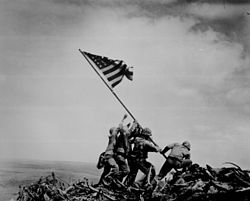
Next week will mark the 67th anniversary of the taking of one of history’s most famous – and certainly one of its most reproduced — photographs.  Shot by American Associated Press photographer Joe Rosenthal on February 23, 1945, it captured the remarkable image of six Marines from East Company raising the American flag on Mt. Suribachi, Iwo Jima.

The first AP editor to see the photo in a darkroom in Guam reportedly exclaimed, “Here’s one for all time.”

My friends and family know I love history.  And I am a sucker for a good history story… especially if there are pictures to go with it!  So on Monday I attended a lecture at Stanford University by Hal Buell, former head of the Associated Press Photo Service, and Author of Uncommon Valor, Common Virtue, the story of the Iwo Jima flag raising.   Mr. Buell retraced the impact of the famed Iwo Jima photograph on Mr. Rosenthal, and America.

The war in Europe was easy for Americans to understand and relate to.  They could visualize – and had perhaps even visited — London, Paris or Berlin.   The war in the Pacific, however, was waged on tiny islands most Americans had never heard of like Mindoro and Sulu Archipelago – with casualties that were inconceivably massive.  Joe Rosenthal’s photograph helped provide context, understanding, and a desperately needed morale boost back in the U.S.  It won the 1945 Pulitzer Prize, and Joe Rosenthal was awarded $1,000 (the only real money he every made from the photo).

In April 1945, on President Roosevelt’s direction, the photograph was the central image of the 7th (and final) bond drive of WWII, which was hugely succesful.  The photo was ubiquitous; it could be found on murals in bank lobbies, train stations and schools, on war posters and even on postage stamps — a coup, as postal service policy prohibited the use of images of living people on stamps.   (Of the six Marines who raised the flag only three survived until April.   Those three remaining flag raisers reluctantly agreed to participate in the bond drive.)

While Americans everywhere recognize Joe Rosenthal’s iconic photograph, many are unaware of the controversy that has surrounded it.  It was not, in fact, a shot of the first flag raised on Iwo Jima.  That original flag was photographed by military photographer Staff Sergeant Louis R. Lowery, but was lowered a few minutes later on the orders of the Secretary of the Navy who wanted it as a souvenir.  Joe Rosenthal captured the raising of a second, larger flag.   He happened to be in the right place at the right time, well after Lowery headed back down the mountain.

Joe Rosenthal did not, as was often claimed, stage his photograph, nor did he try to cover up that there was a prior flag raising.  Yet skeptics accused him of everything from planting the flagpole himself to stealing the film from the camera of a fallen Marine.

Rumors were further fueled by a remark Mr. Rosenthal made before he’d learned that his flag-raising photograph had become a sensation in the U.S.  When asked about the impact of the image, he assumed the question referred to his photo of Marines cheering alongside the already-raised flag (right), which he described as “posed”.
Film footage of the flag raising from Sergeant Bill Genaust, a Marine motion picture photographer, bore out the photo’s authenticity, yet Life Magazine jumped on the story by accusing Rosenthal of staging on its radio show.   Life later broadcast a retraction, but the damage had been done.

Hollywood helped perpetuate other myths about the raising of the flag on Iwo Jima, often showing fierce Japanese sniper fire during the event – which never happened — and choosing macho actors like Lee Marvin to portray the humble real-life flag raisers.

The Marine Corps War Memorial at Arlington National Cemetery was modeled after Joe Rosenthal’s photograph.  When it was dedicated by President Dwight D. Eisenhower in 1954, participants from the first flag raising were in attendance and again expressed bitterness at the lack of recognition they had received.  No reference was made to Mr. Rosenthal on the statue until 1978, when a plaque with his name was added to the monument.

Given the frustration and humiliation his famous photograph sometimes brought him, Joe Rosenthal was often asked if he ever regretted taking it. Or, did he ever wish someone else had taken it?

No, he replied.  He did his job, and he was proud of the picture.  Besides, it didn’t matter that he took the photograph – what mattered was, the Americans took Iwo Jima.    Well put, Joe.

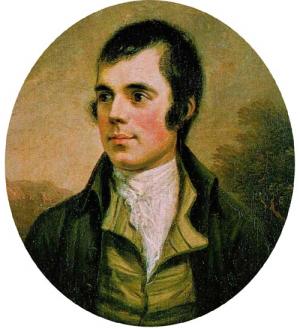
Happy Burns Night!

Robert Burns

Sláinte Mhath!  Or in other words “Happy Burns Night”!  Aye, it’s January 25th, the day when Scots — and Scot-ophiles — everywhere celebrate the birth of famed Scottish poet Robert Burns (1759 – 1796).

A fascinating tidbit from Wikipedia:  While Burns Night generally coincides with the poet’s birthday, the celebrations may “in principle” be held any night of the year.  Nice to know that if you ever decide to hold a Burns Supper in July, you won’t face fines or jail time.  You will, however, run the risk of a hangover beyond anything you might experience after even the rowdiest July 4th barbecue.  Burns Night tends to be held once a year, because most of us wouldn’t survive if it happened more often.

In some ways, Burns Night resembles Thanksgiving in the United States. There is no retail component, so no gift giving is required.  And there’s an emphasis on food and drink.  But at its core, Burns Night is all about gratitude — Scots’ gratitude because they get to be Scottish.

I’ve attended a few Burns Night celebrations over the years, and they are a blast.  Men wear tartan kilts and “Address The Haggis”.  The poem is a long one, so I won’t repeat it all here. But it starts with:

“Fair fa’ your honest, sonsie face,

Great chieftain o’ the puddin-race!

Aboon them a’ ye tak your place,

Painch, tripe, or thairm:

Weel are ye wordy o’ a grace

As lang’s my arm.”

The basic meaning?  Haggis is the most Scottish of Scottish main courses, and it deserves a grace that’s eight stanzas long (i.e. as long as my arm).

Not a fan of stuffed sheep’s innards?  Go for extra helpings of neeps and tatties (turnips and potatoes) washed down with single malt Scotch. Eventually that haggis will look and taste like Niman Ranch tri-tip. Trust me.

Alas, this year Burns Night fell on Wednesday.  Hump Day.  Whole Foods was fresh out of haggis.  And without haggis, neeps and tatties are nothing more than… vegetables.   So I made due.  I ate whole-wheat pasta with leftover pesto and parmesan, then took a wee peek at my Penguin Classic “Selected Poems of Robert Burns”.  I listened to “Sunshine On Leith”, an ode to Scotland by The Proclaimers.  And I marked my calendar for January 25, 2014… when Burns Night falls mercifully on a Saturday!

Tweet This!

At this point, nearly everyone knows that the San Francisco 49ers will not be going to the Super Bowl this year.  They have also heard about the two fumbles by wide receiver Kyle Williams that helped cost us the game, and the threatening messages he received via Twitter afterward.

I was reluctant to write about the 49ers’ loss, and the extreme reactions to it by some.  What more is there to say, that hasn’t already been written, blogged or tweeted?  But yesterday’s events raised several questions that lingered in the back of my mind all day.

Why does Twitter bring out such hatefulness, particularly on the topic of sports?   Some chalk it up to the anonymity that is available with social media.  They say people lose the will to censor themselves, if their words can’t be traced back to them.  This may be true in some cases, but most of the comments I saw yesterday came complete with full names and photos attached.  If these guys thought they were incognito, they are even dumber than their tweets suggest.  (Why is it that the nastiest tweeters are also incapable of spelling the word “you’re” correctly?)

Perhaps it’s less a matter of anonymity, than of proximity (or lack of it).   I doubt that yesterday’s tough-talking-tweeters would have been so bold, if a 49er had been within swinging distance.

Are these folks just uber-competitive athletes who love and understand the game better than the rest of us?  Doubtful.  I envision washed up high school sports heroes long since gone soft, and guys who passed out towels after practice… but like to pretend they did a whole lot more.  Regardless, they know nothing of sportsmanship, teamwork or compassion.

Where does that kind of venom come from? Alcohol?  Probably a factor, but that’s the Mel Gibson defense which always seemed a little shaky to me.  Alcohol may give you liquid courage to blurt out something you shouldn’t, but it doesn’t plant the idea in your head and heart in the first place.

I sense the pack mentality at work.  At its best, Twitter is a conversation, and just like in face-to-face interactions participants want to be liked – even admired.   We want to make other people laugh.  We are flattered and validated by follows and retweets.  So it’s easy to dog pile on a struggling pitcher after his fifth walk in two innings, each tweet a little more biting than the last, to keep the conversation going.  If he can’t take the heat, he should stay off Twitter, right?

On the whole, I think social media is a blast.  But just like in “real life” I choose who I interact with carefully.  I surround myself with people who lift me up, make me laugh and challenge my thinking.  In turn, I try to stick close to my values and apply common sense rules to my part of the conversation.  If the person I’m writing about read this, would I feel guilty?  Could I look him/her in the eye and say it?  Would I be OK if a stranger wrote something like this… about me?  If the answer to any of these is “no”, I do the digital equivalent of biting my tongue, and hit delete.

Women With Nibbles… Proceed With Caution!

This evening I attended a professional women’s networking event that occurs monthly in downtown San Francisco.  It was held at a popular clothing store, and attendees (all of whom paid up to $35 to attend) were treated to champagne, cheese and crackers and, if they stayed around long enough, a coupon for the store.  (Spoiler alert:  I did not stay around long enough.)

Free food + free champagne + coupons = a very hot, over-crowded room full of glassy-eyed women about to launch into a retail frenzy.   Many could care less about tonight’s speakers.  All of this reminded me of the two reasons I usually avoid hot, over-crowded rooms full of women.

Reason one:  If you’ve gone to a cinema recently, you know that humans must be told up to five times before an event that involves quiet to silence their cell phones.  These admonitions are not directed at everyone, however — don’t be fooled.  They are directed at women.  Professional women who can manage teams, oversee P&Ls, and bring home the bacon then fry it up in a Le Crueset pan are apparently genetically incapable of remembering to turn their cell phones to mute.  During tonight’s 45 minute panel discussion, the cell phones of three women standing either in front of or next to me rang. Each time the owner seemed sheepish, and shocked — SHOCKED — that she had forgotten to turn off her cell phone.  Ooops.

My crazy theory?  At least some of the women knew perfectly well their phones were set to “loud”.  They are just so addicted to multi-tasking, so afraid of missing something, so unaccustomed to just being in the moment… they consciously did not mute their phones, despite the fact that it could mean a disturbance for others.  Clearly, this makes me crazy.  I, of course, turned my cell phone off as soon as I arrived. This leads me to my second reason for avoiding hot, over-crowded rooms full of women.

Reason two:  Women going after free food and drink, and/or who are in a retail frenzy, are sloppy clods.

I walked into the room tonight, and knew I would be miserable.  With the exception of the 2010 World Series Parade, I have never enjoyed teeming humanity.  I love cities, but I hate crowds.  I located a free spot to plant myself (standing, of course) and placed my briefcase on the floor by my feet. Then, responsible community member that I am, I leaned down to locate and mute my cell phone.  That’s when the woman to my right spilled her champagne AND her plate of cheese and crackers all over my back.  That is, all over my new camel coat — a post-Christmas sale splurge at Bloomingdales.  I almost did not wear the coat today (for the first time, no less) because I was afraid someone would spill wine on it.  But, that’s silly right?  Why buy nice things, then hide them away in the closet?  It was a networking event, not a frat party!

When did holding a plate AND a glass at the same time become a lost art for so many?  Seriously, if you can’t do both can you please choose just one? The woman apologized, even offered to pay for the cleaning, then turned to her friend.  “This is just a disaster.  This has been a disaster!” Really?  A disaster for whom?  Her loss was her free champagne and cheddar cheese. I bet she still got a coupon!  I was the one who smelled like Charlie Sheen after a night out on the town!  People on the bus home stared at me.   “Poor woman.  Well dressed.  Nice coat!  Too bad she’s an alcoholic.”

Luckily it was champagne, not red wine.  So no real harm done, except to my faith in the judgement and dexterity of some women.  I will exceed my dry cleaning budget in January, but that’s OK.  With the money I DON’T use for women’s networking events in February I should break even!