
Rise Above It: Staying Grounded In An Escalation-Happy World

Two arguing children stick their tongues out at one another.Gather ’round, workers of the world.  Today I am voicing my exasperation with behavior that has lately been chapping my hide: superfluous escalations. Corporate America is stinking with them

Don’t get me wrong, escalation can be warranted, like when a project team has tried every avenue of negotiation and bargaining to resolve a difference of opinion but has reached an impasse.  Raising the discussion up to more senior leadership can break the logjam.

On other (rare) occasions, when a rogue colleague is having a toxic effect — proving immune to charm, logic, reason, and pleas for civility and partnership — a constructive chat with his/her manager can be a reasonable course of action.

What a pity that many workplace escalations do not resemble either example.  Instead, they are little more than tattling, with some lipstick smeared on to pretty things up.

Such tattling takes many forms, but is usually based on the perception that escalation is the surest path to “yes”.  Hoping a colleague will take on a particularly nasty task that falls outside his job description?  If you ask him, he could say “no” so why not just head straight to his boss to get buy-in?  It may alienate and disfranchise your colleague, but don’t worry — if he gets huffy you can always escalate!

Sometimes it is less about speed than effort.  You could invite Sally to coffee to iron out your differences, but resolving conflict is so awkward and time-consuming, and a trip to Starbucks is a long walk in those three-inch heels of yours.  Meanwhile, Sally’s boss’s email address is so handy…

Tattling-type escalations are part of a zero sum game.  They are not meant to reach a mutually beneficial agreement, and move things forward, but to score a “win” by excluding the opposing party from the conversation.

Over the course of my career, I’ve determined that organizations where escalations run rampant have one thing in common: manager overreaction.

Humans are hardwired to find the path of least resistance, and keep to it – like lab rats that memorize the quickest route through a maze to reach the Velveeta.  Likewise with managers who fail to react thoughtfully to escalations.  They set a precedent, and reward the behavior until it is pervasive.

A few years ago, a colleague complained that a member of my team, P., was stepping on her toes on a project.  She was frustrated, and wanted me to set P. straight.  “Have you shared your concerns with her?” I asked.

Clearly this was not the response my colleague was anticipating.  “No I didn’t tell HER.  I’m telling YOU!  You are her MANAGER.”

I didn’t bite.  I suggested that the two at least try to work out their differences without my intervention.  And guess what?  I never heard another complaint.  They may have butted heads from time to time, but they sorted it out.  The project launched successfully, and the futility of tattling to me as a first resort was established.

In some organizations, consensus is king… at the expense of constructive conflict, which is a natural byproduct of workplace diversity, innovative thinking and healthy debate.  Fear of escalation can become punitive, so workers go into self-preservation mode by playing it safe.

What do you think, workers of the world?  Do you agree that workplace escalations are on the rise?  If so, what’s causing it?  How can organizations better encourage professional adults to collaborate and negotiate, rather than tattle?

Your ideas are welcome, no escalation required.

Losing Lincecum

Timmy exhalesSan Francisco Giants pitcher Tim Lincecum got roughed up again tonight, this time by the Atlanta Braves.  He walked five, and gave up two earned runs in six innings.   The Giants lost 3-0, and while there’s plenty of blame to go around (I’m thinking of Andres “Butterfingers” Torres right now), there is no denying that Timmy’s problems are not just a temporary funk.  His performance has not improved this season, even though he reportedly showed up to spring training in the best physical shape of his career.

I am a longtime, diehard Lincecum fan, and his downward spiral has been tough to watch.  Of course I hate to see the Giants lose and all, but what’s harder to witness is Timmy’s complete loss of confidence.  The swagger and fist pumps are long gone, and now he just looks lonely and lost out there on the mound.

I’ve only seen Timmy pitch in person once this season – against the Colorado Rockies in late May – and finally got around to going through my shots of that game this evening.  (I’ve been a little busy lately, for reasons I’ll blog about soon.)

His facial expression and posture are so different than in seasons past.  I can see this on TV, but was surprised by how obvious the change is in these photographs.

When scrutinizing the hundreds of photos I took, deciding which to edit and keep and which to delete, I probably saved more than made sense.  Each time I watch Timmy struggle mightily these days, I wonder how many more times I’ll get to see him start.  I also wonder how much longer he’ll wear a Giants uniform.  It’s hard for me to imagine the team without him.

These are just a few of the keepers, mostly of Timmy:

This slideshow requires JavaScript.

True Confessions of a Judgemental Traveler

Sleeping woman wearing a travel neck pillowThere was an extended period in my life when I traveled often by plane. Transcontinental flights, too. So I am someone who appreciates the need for comfort when taking to the friendly skies. I keep it casual, but I have my standards.

No linen or silk. No skirts or pantyhose, or complicated hairstyles that get mussed by burlap upholstery or an ice-cold airstream pointed squarely at the top of one’s head. When I fly overseas for personal travel, I may wear yoga pants… but never sweats. And if I take off my shoes, I’ll absolutely be wearing a clean pair of socks. Under no circumstances will I be seen sporting flip-flops on an airplane.

I get regular pedicures, that’s not the reason. I guess I’m just trying to pay it forward; if I don’t make my seatmates look at my feet, maybe I won’t be forced to look at theirs? (Ever spent hours cozied up to a barefooted stranger with toenail fungus? If yes, you’ll agree that sock-wearing is a good policy.)

Buster Posey at bat
Buster Posey

Because these days my trips (especially business ones) tend to be domestic, and rarely more than six hours each direction, I don’t see the need to dress down too much. Even if I didn’t run the risk of bumping into colleagues on every flight I take, you never know right? I could meet my Mr. Right on that plane. Or even better, my Mr. Buffet or Mr. Spielberg or Mr. Clinton. Or maybe even Mr. Buster Posey!

Last week I traveled from San Francisco to Charlotte, North Carolina. As I meandered around the airport after being scanned and swabbed for explosives, I took a long, hard look at my fellow passengers and was frankly horrified. Since when does a five-hour flight warrant wearing flannel pajama bottoms, an old t-shirt and flip-flops?

I don’t get it. I spend eight hours each workday with my lower half tucked beneath a desk or conference room table, and I do it wearing business casual. Why is loungewear required for a measly five-hour flight?

Excuse me, sir. Are you flying to Charlotte, or on your way to clean out your garage?

The funniest part: Many of my fellow passengers that day chose to accessorize their sleepwear/travel ensembles with inflatable neck pillows. Meaning, they didn’t carry the pillows under their arms or in their hands, or stuff them into their carry on bags. They wore them around their necks as they strolled around the concourse.

This must signal either profound laziness, or extreme exhaustion resulting in a complete disregard for street cred. It was like being surrounded by narcoleptics, who could nod off at any time.

Maybe United Airlines could institute a new rule – all inflatable sleeping accoutrements must be safely stowed under the seat in front of you, until the plane has reached cruising altitude.

Passengers, help United help you!

Anyone else noticed this phenomenon?

People Who Eat Darkness

 People Who Eat Darkness: The Fate of Lucie Blackman by Richard Lloyd Parry Each holiday season I wait impatiently for the release of the Best-Books-of-the-Year lists, just as I used to look forward to the Sears & Roebuck Christmas Catalog as a child.  Back then I would make a first pass, methodically scouring each page and folding down the corners of those featuring a toy my heart desired.  Then — knowing it didn’t pay to be greedy when it came to Santa Claus — I’d take several more passes, making heartbreaking trade-offs and turning some corners back up, until I had a wish list I figured the fat man wouldn’t reject.

This serious, methodical, war-of-attrition approach to choosing among large lists of things, when most of those things look pretty great, has carried into my adulthood.  It’s definitely my strategy for stocking up on books each year, with the help of the discriminating folks at the New York Times.

The New York Times 100 Notable Books of 2012 list included a book I’d never heard of; it captured my attention immediately and I downloaded it on the spot.  People Who Eat Darkness: The Fate of Lucie Blackman by Richard Lloyd Parry is the story of the disappearance of a 21-year-old British woman working in Tokyo in the summer of 2000, the seven month search to find her, and the eight year legal battle to bring her killer to justice.

I was drawn to the book first and foremost because I taught English in Japan in the early 1990’s to escape a recession that was decimating public relations (my chosen profession at that time) in New York, and to save money for business school tuition.  I was posted to a small rural town more than one hour by bus and train from Kyoto, where I was the only Westerner for miles and therefore the object of some fascination. 

Lucie lived in bustling Tokyo among many foreigners, and worked in a Roppongi district hostess bar.  Her brief experience in Japan was very different from mine, but I suspect there were still similarities. 

As he describes the last day of her life, the author explains what it’s like to be a foreigner, walking down any street in Japan.  I experienced this, and I’ll bet Lucie did too.

“The crows flap and complain as Lucy steps outside.  As she does, she experiences the small daily shock of reentry that every foreigner in Tokyo knows.  A sudden, pulse-quickening awareness of the obvious: Here I am, in Japan.  Every morning it takes her by surprise – the sudden consciousness of profound difference… Even after years and decades have passed, you never get over the excitement, the unique daily thrill, of living as a foreigner in Japan.”

A similar observation:

“In twenty-first century Tokyo, people rarely stared openly at foreigners, but always one was conscious of being an object of an unaccustomed attention from the rest of the human population – not outright gawping, neither unambiguous affection nor disapproval, but simply the discreet registering of difference.  In Japan, you become a citizen of a new nation – that of gaijin, the foreigner.”

People Who Eat Darkness is not just a mystery or a thriller.  It’s also a commentary on the stark differences between Japanese and Western cultures that can take gaijin who travel to Japan completely by surprise.   This was another reason I bought – and was riveted by – the book.  For example, it dives deep into the discrimination against Korean nationals –like Lucie’s killer Joji Obara – in Japan.  They may have been born and educated in Japan and speak only Japanese, been raised on Japanese food, and even amassed enormous wealth, but they are treated as a lower caste of society. 

It is also an examination of the slow-moving Japanese criminal justice system.  In Japan crime rates are low, and the vast majority of suspects confess before their cases ever go to trial, thanks in part to some rather heavy-handed police tactics.  Judges and the public are accustomed to these confessions – and the motives expressed while making them  — to the point of being flummoxed by the case of Obara, who refused to own up to his crimes despite overwhelming circumstantial evidence.  The outcome of the trial was – and still is – shocking.

Finally, People Who Eat Darkness is the story of a family – most specifically a divorced couple, Lucie’s parents Tim and Jane – so toxic and bitter it will both infuriate you, and break your heart.  The Blackmans had divorced acrimoniously nearly a decade before Lucie’s murder, and continue to undermine and lash out of each other to this day.  There was no attempt at unity in the face of so much loss and pain. 

After a few chapters reading about the Blackmans, I suspect you’ll feel the urge to give your own parents a big family hug.

I thought I vaguely remembered the case of Lucie Blackman, but as I read People Who Eat Darkness I realized that my recollection was more than a little fuzzy. (According to Lloyd Parry I am not alone in confusing Blackman’s case with the grisly murder of another British woman working in Japan, Lindsay Hawker, a few years later.)  

Maybe my misapprehensions were due to time passing, or the US media not being thorough in reporting the story.  Or perhaps, so soon after a year in Japan that had left me slightly jaded about the culture and customs, I unconsciously built a memory that was biased and lacking in nuance.

Regardless, I feel fortunate that the book jumped out at me from the New York Times Books section last December, and that it passed my exacting screening process.  If you’ve ever lived in Japan, or have a keen interest in its culture, People Who Eat Darkness will resonate with you.

Matt Kemp: Goodness, Gracious

Los Angeles Dogers outfielder Matt Kemp warms up.
Matt Kemp

As I blogged yesterday, I attended the San Francisco Giants game against the Los Angeles Dodgers on Sunday.  A grudge match, as usual.

One thing I failed to mention in my post:  After the game — which the Dodgers lost — a gracious Matt Kemp jogged over to my section and gave half his uniform to a young, disabled Dodger fan seated almost directly in front of me.  No hoopla or posing.  No cameras around, except for the personal iPhone of someone seated nearby that was used to shoot this video.  (Unfortunately, I had already stored my camera away by that point, and the encounter happened too fast for me to pull it back out.)

No exaggeration, you could have heard a pin drop in section 125.  Kemp, who gets booed with every at-bat in AT&T Park, left a number of us pretty choked up.  The young fan was at the game with an older gentleman — probably his Dad — who was obviously thrilled and touched beyond words.

I am not much for heckling opponents, so I was never among the Matt Kemp booers to begin with.  But going forward, I may manage some polite clapping, instead of stoney silence, when he’s at the plate. 

I’m not sure I could manage flat-out cheering, though.  He does, after all, still wear Dodger blue.

Giants vs. Dodgers: A Clean Sweep

San Francisco Giants pitcher Matt Cain on the mound, May 5, 2013.
Matt Cain

The San Francisco Giants beat the Los Angeles Dodgers three times last weekend. Swept the floor with them, you might say.

I caught Sunday afternoon’s game — the last of the series and a 4-3 victory for my guys.  My seat was near third base — a more favorable location this season, since the team has found its offense.  In years past, when only one or two Giants players even made it to third base, let alone scored, it could feel like the loneliest, saddest place on earth.

Matt Cain — who was winless in April — looked strong.  Hunter Pence was en fuego. (Sunday was Cinco de Mayo, after all.)  Andres Torres ran very fast.  And Pablo looked… like a fat panda.  His online bio puts his weight at 240 pounds, but these photos don’t lie.  The guy is a house.

Right now Sandoval is batting .323, but you have to wonder how long he can maintain that when he huffs and puffs around the bases… and can no longer see his toes while doing it.

On a lighter note, being back at the ballpark on a warm day — camera in hand — brought me all the usual joy.

And as my tagline says… I have the pictures to prove it.

This slideshow requires JavaScript.

Don’t Tread On Me

Don't Tread On Me cartoonJodie never sleeps ’cause there are always needles in the hay
She says that a girl needs a gun these days
Hey on account of all the rattlesnakes — Lloyd Cole, Neil Robert

That’s from one of my favorite songs from my college days: “Rattlesnakes” by Lloyd Cole and the Commotions. It’s been stuck in my head for two days, since I encountered my first-ever rattler on a hike in Marin County, California.

It was quite a brush with danger for so early on a Saturday. I was on the back nine of my hike, so to speak, stumbling down the hill with my headphones on and not paying much attention to anything. The site of the snake sunning itself smack in the middle of the trail stopped me dead in my tracks. I saw the rattle, and knew my hike was going to take a little longer than expected.

Now, if you ask someone in the NRA’s leadership — Executive Vice President Wayne LaPierre, for example — he will claim I probably wished I’d had a gun right then. (That’s the same thing the NRA is saying about Aurora, Newtown and even Boston.)

Nothing could be further from the truth. I wished I had brought sunscreen, for sure. And my cell phone to capture the moment. I probably also could have used a very, very long stick and a sturdy burlap sack, but I never once wished I had a gun.

I didn’t need to blast the snake into teeny tiny bits with a semi-automatic firearm to make my point.  I made do with rocks scattered along the trail, which I threw at it David-vs.-Goliath style. Not enough to make it feel threatened, but just enough to be a nuisance that wasn’t worth sinking its fangs into. Eventually it slithered away.

No harm done.  I got an entertaining story — ripe for embellishment over time — that I can tell at parties.  I also got the benefit of a much-needed cardio boost from fear, and from sprinting past that snake in a rather embarrassing fashion.

I’m not kidding, once it was out of sight I flew through the rest of that hike.

And so it is that I now have a classic, blast-from-my-past song stuck in my head that keeps making me smile.  Maybe it’s stuck in your head now too, thanks to the power of suggestion.  If so… enjoy!

When It Comes To Burning Bridges, It’s Go Big Or Go Home

LinkedIn Cartoon iconLast week, the professional social network LinkedIn invited its “thought leaders” and other content contributors to write about the best  — most counter-intuitive – mistakes they had ever made.  It was pretty tame stuff, nothing controversial: “My Best Mistake: Nearly Getting Fired”, or “My Best Mistake: Forgetting the Five-Year Career Plan”.

On Thursday, however, a LinkedIn user made his own big mistake – and something tells me it wasn’t his best. If it was?  Have mercy.

On that day a large, established eCommerce/payments company posted a story, as firms and individuals on LinkedIn often do, titled “How Busy People Find Time to Think Deeply”.   Again, innocuous stuff.  Most of us are busy, and who among us wouldn’t appreciate more time to think deeply, right?

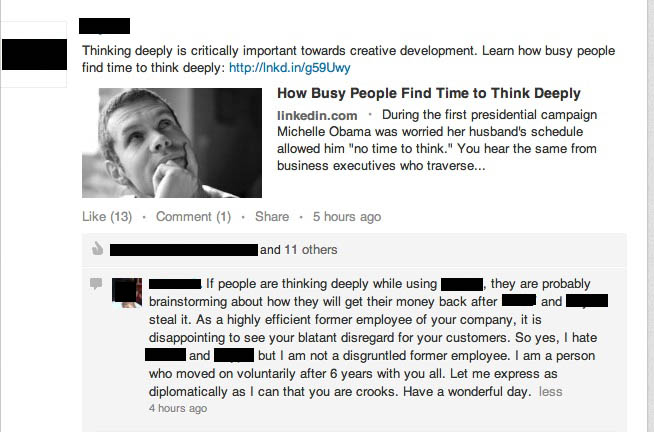
It was in response to this article that a former employee inexplicably chose to air grievances with the firm.  I’ve omitted a few specifics to protect the clueless:

“If people are thinking deeply while using (company’s product), they are probably brainstorming about how they will get their money back after (company and its parent) steal it. As a highly efficient former employee of your company, it is disappointing to see your blatant disregard for your customers. So yes, I hate (you, company) but I am not a disgruntled former employee. I am a person who moved on voluntarily after 6 years with you all. Let me express as diplomatically as I can that you are crooks. Have a wonderful day.”

Completely floored, I sent the link to friends, encouraging them to click on it only if they weren’t squeamish about professional suicide. None of us could conceive of why someone would be so hell-bent on offending both his previous employer AND anyone else who might possibly think of hiring him.  What was he trying to accomplish?

Would you make an offer to someone who holds such consuming grudges, and voices them so recklessly?  Someone who might leave your employ, then paint you as dishonest on social media?

What drives folks to self-destruct on social media this way?  I mean, we’ve all heard stories of knuckleheads who call in sick, then tweet photos of themselves doing keg stands on the beach.  Or who unload on their toady bosses on Facebook, and are summarily fired.  Still, I think this one takes the cake.

If not him, then maybe the unimaginative guy who piled on with, effectively, “Yeah, what he said”.  In the words of Forrest Gump…Stupid is as stupid does.

Aside from the obvious sarcasm in his “have a wonderful day” sign off, you’ve got to love that this guy doesn’t consider himself a disgruntled former employee.  Really?  If his bridge-burning behavior doesn’t scream “disgruntled”, I don’t know what does.  Plus, I think he protests that he left the company voluntarily just a smidge too emphatically.  I’m just not buying it.

Here’s hoping the poor fellow has some friends who can appeal to his better judgment – assuming he possesses any – and convince him to remove the comment.  It had to feel GREAT to blast his old bosses this way, but by now he has probably received quite a few concerned emails asking if he has completely lost his mind.

My Dad once told me a story of a colleague who, many years ago, got drunk at the office Christmas party and told off his bosses.  Within a week, he was transferred to someplace like North Dakota.  In the dead of winter.

Going out in a blaze of glory can sound cool, but pack your suitcase wisely… exile can be a cold place.

Have any good bridge-burning stories?  Share ‘em if you’ve got ‘em.

LinkedIn comment: If people are thinking deeply while using (company’s product), they are probably brainstorming about how they will get their money back after (company and its parent) steal it. As a highly efficient former employee of your company, it is disappointing to see your blatant disregard for your customers. So yes, I hate (you, company) but I am not a disgruntled former employee. I am a person who moved on voluntarily after 6 years with you all. Let me express as diplomatically as I can that you are crooks. Have a wonderful day.

So the Pot Called the Kettle… Opportunistic and Insincere

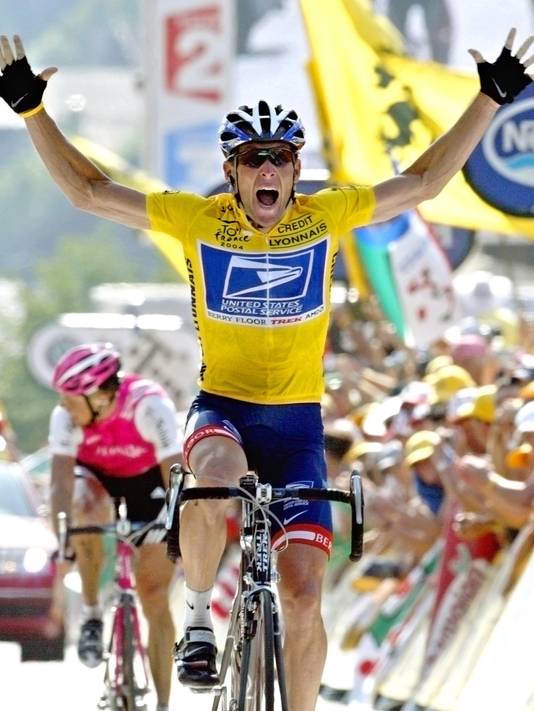
Lance Armstrong
(Photo: Laurent Rebours, AP)

The United States Justice Department has announced that it will join a federal whistle-blower lawsuit against Lance Armstrong brought by Floyd Landis, his former teammate on the US Postal Service cycling team.

Former team director Johan Bruyneel and Tailwind Sports were also named as defendants in the suit.

The complaint states:

“Riders on the USPS-sponsored team, including Armstrong, knowingly caused material violations of the sponsorship agreements by regularly and systematically employing banned substances and methods to enhance their performance… Defendants were unjustly enriched to the extent of the payments and other benefits they received from the USPS, either directly or indirectly.”

This wasn’t exactly a surprise, since today (April 23) was the deadline for joining the suit.  And as anyone who likes to receive mail on Saturdays knows, the USPS is financially strapped and could really use a big injection right now.

Of cash, that is.  A big injection of cash.

Lance Armstrong’s lawyer’s response to the government’s action was classic.  He called the lawsuit “opportunistic and insincere”.

For a moment, I thought he might have been describing his client.

BOOM!

Too much?

It’s ON, America

The Green Building at MIT
The Green Building at Boston’s MIT. (Photo: Matthew J. Lee / Globe Staff)

Thirty-six hours ago, Americans were reminded of a few things.  Obviously, and most painfully, we were reminded that no amount of security and vigilance can ensure our safety in the age of terror.

You may subscribe to the notion that nothing stops a bad guy with a gun, except a good guy with a gun.  (I do not agree, although that’s a subject for another blog post.)  But how do we stop a bad guy with a bomb?  Or two?  Sometimes we can, but on Monday in Boston we could not.

Today I’ve heard a few frustrated folks lament that an evil few can destroy the happiness and freedom of the many.  I don’t think that’s the lesson here.  Rather, the take-away message should be that there is more good in the world than bad.  As Patton Oswalt (!) so elegantly put it in a Facebook post that has now gone viral:

“We would not be here if humanity were inherently evil. We’d have eaten ourselves alive long ago…

When you spot violence, or bigotry, or intolerance or fear or just garden-variety misogyny, hatred or ignorance, just look it in the eye and think, ‘The good outnumber you, and we always will.’”

Much of that good has already been well chronicled this week, like the Boston Marathon runners, bystanders and volunteers who rushed toward Monday’s carnage as soon as it happened, rather than away from it.  Acts of courage and selflessness were everywhere, witnessed by helpless citizens of the world who could only tune in via social media and pray.

Twitter 1
By day’s end, Boston-area blood banks were fully stocked and thousands of residents had offered space in their homes to weary, terrified runners with nowhere else to go.

The New York Times suspended its pay meter (the tracking mechanism that prevents non-subscribers from reading more than a few online articles per month for free) to allow everyone access to news.

There were other acts of goodness, such as heretofore unseen restraint among most news outlets and social media users.  We were all urged to corroborate what we heard, before presenting it as fact.  Shocking tweets were challenged with, “What’s your source for that?”.  Many outlandish rumors sputtered and died under the weight of scrutiny.

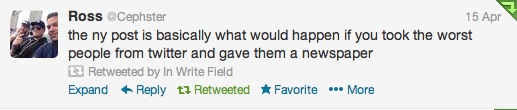
The New York Post was the most glaring exception, exaggerating the number of casualties and claiming that a suspect was in custody within two hours.  The Twitter community rallied to bring the hammer DOWN on those hacks.

Twitter 2
Even President Obama was careful when addressing the stunned nation.  Some were frustrated that he avoided using the term “terrorism”.  I suppose it’s reassuring to label a heinous act, as a means of trying to understand it, but I was glad that the President chose not to influence the narrative by using loaded words when he lacked facts.

Once we catch whoever did this, feel free to label it however you like.

On a similar note, most Americans took a holiday from bipartisan bickering on Monday.  Let’s hope it’s an extended one.

Tweet 3
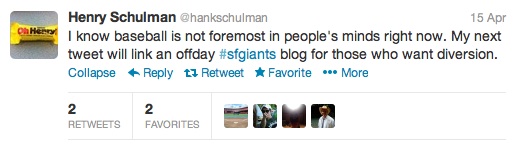
As always, sports proved a great distraction and rejuvenator for me.  Sports writers were especially respectful.  Despite the tragedy they had a job to do, but most showed sensitivity.  Hank Schulman, for example, tweeted this before sharing a link to his most recent blog post:

Tweet 5
Teams everywhere celebrated life and courage and community, and they did it with class.  The “United We Stand” banners at Yankee Stadium featuring the Red Sox logo?  Those choked me up almost as much as the Yanks playing Fenway favorite “Sweet Caroline” tonight, as fans laughed and sang along.  The resilient laughter – that’s what got to me.

In a way, sport is a great metaphor for the reaction to yesterday’s insanity.  America is complicated and messy.  Sometimes we behave badly, and fight ferociously amongst ourselves like a bunch of toddlers trapped in a room with only one toy.

At the end of the day, though, we’re a team.  If you attack one of us, you’re going to face the wrath of all of us.

Pity the evil person or persons who messed with my team.  We’re bringing our A game.  We will win, because the good guys always do.