
Suits Me

Hillary Clinton in various pants suitsI wore a suit to the office today, for the first time in probably 5 years. It was a pants suit – a suit suited to Hillary Clinton, you might say.

Since my work team settled into our new high-tech, low-walled digs earlier this month (we’re all still speaking to one another, by the way), we have withstood regular “tours” of colleagues keen to check out our fancy space. This morning we were scheduled to welcome the granddaddy of all tours, by the biggest of our company’s big wigs. And so, we were expected to dress up.

Years ago I pledged myself fully to business casual, and so have only two suits tucked away in my closet. Trying them on last Friday evening was a nail biter. If they no longer fit, I would be spending my weekend shopping, instead of Olympics-watching while the soothing rain beat against my windows. Luckily, everything buttoned, snapped or zipped as intended, and my cocooning weekend was saved.

On this morning’s commute to the office, I had flashbacks of living in Manhattan after college, and riding the E train to work. We were packed in like veal, and condensation ran down the bus windows while perspiration ran down me. As I suffered, I remembered how happy I was to say goodbye to pumps and pantyhose, and layer-upon-layer of dry clean only. Denim breathes, am I right?

In New York, you’d have to look closely to spot the difference between Friday attire, and what we wore on every other workday. Business casual at a bank only meant your blazer and skirt could be made of different fabrics. Jeans at an office? Not unless you were paid to clean it.

Later, when I moved to San Francisco and joined a large brokerage firm, business casual had morphed a little – but some in senior management fought the trend. Even after it was officially sanctioned corporate-wide, the head of my division prohibited shirts without collars for men. I don’t care if you were wearing a silk Armani t-shirt under a cashmere sweater… if he spied you, he sent your boss a curt email threatening to send you home next time.

Twenty years later, nearly everyone I know is casual, every day. So it’s strange, when you think about it, that interacting with the C-suite still means full business attire. As one of my teammates pointed out, we ride the elevators and share the lobby with these executives; surely they’ve seen what we usually wear?

(Besides, I’m not sure I stood up from behind my desk during the tour; I could have been wearing culottes and high-tops under there, for all they knew.)

I suppose one explanation is, formal business attire is a known quantity. Instruct a team to wear it, and everyone will understand: men in ties and jackets, women in dresses or suits.  But business casual can run the gamut from polished… to looking like something best worn to clean out the garage.  Remember interns in flip-flops at the White House?

Business casual is here to stay – it’s too late to un-ring the bell.  And I’m very happy about that. It saves me a bundle on dry cleaning. But at least in my industry, putting on the dog for senior management isn’t going away either — and that’s OK. We have one more tour this week, and I’ve got one suit left before I have to repeat today’s ensemble.

Come Wednesday, I’ll be getting my denim on.

Office Cubism: A Survival Guide

Traditional office cubicles

One of my favorite movie quotes comes from When Harry Met Sally. The two visit their friends Marie and Jess, who have just moved in together. They arrive to find the couple embroiled in a heated argument over a coffee table that Jess brought to their new apartment. When Jess defends his aesthetic sensibilities, Marie sets him straight.

“Everybody thinks they have good taste and a sense of humor, but they couldn’t possibly all have good taste.”

Research has shown that we humans give ourselves more credit than we deserve, thanks to a phenomenon known as illusory superiority. In studies, most subjects – regardless of their grasp of basic arithmetic – describe themselves as above average in terms of IQ, work performance, driving, etc.

To paraphrase Marie: We all can’t possibly be better than average. By the same token, we all must fall victim to illusory superiority from time to time, right?

Friends and colleagues who know me well can attest: I need peace and quiet to concentrate. In high school and college, I was a library girl. I couldn’t even study with background music. So, it’s probably no surprise that I am finicky about noise levels at work. Stuff that other folks can tune out… I just can’t. Because I realize my needs are a little outside the norm, I usually keep my lips zipped. I make mental notes, though, that sometimes wind up on Facebook. Mmm hmm. (No names, I promise.)

I’ve had cube neighbors who carried on conversations in baby talk, watched YouTube videos on their laptops without muting them, clipped their fingernails at their desks (snip, snip), cursed out their spouses or cable TV providers by phone… I could go on. I wonder how many of those folks would describe themselves as above-average residents of cube land?

Or what if the person with a case of illusory superiority is (gasp!)… me? Well, I am about to find out.

An example of open cubes, courtesy of Tab Office Resources
Photo: Tab Office Resources

This week, my work team began planning our move to another building – and a space with an open floor plan favored by tech start-ups: limited offices, low cubicle walls and smaller desks for the sake of closer collaboration.  The new space is very cool, with some hi-tech amenities. Still I have to admit, I’m a little nervous about it.

A recent New Yorker piece titled The Open-Office Trap warns of everything from lost productivity to increased stress to health risks from sitting in such close quarters. The article also points out that less privacy and more shared space mean everyone has less control over their environments. When surrounded by four high cube walls, you can decorate how you like and generally be as messy or neat as you want to be — but when your next door neighbor risks a paper cut from the teetering pile of papers on your desk, your pack rat tendencies become a community issue.

Our team drafted an etiquette guide for our new space. Nothing extensive, just a few reminders about being respectful, discreet and volume-conscious in our new home. In case that fails, I’ve also splurged on a pair of noise-canceling headphones. (I’m the man, yes I am.)

I figure the team will hit some rough patches, but I have my fingers crossed that as a group we’ll all defy the odds – and the math – and be better than average at the open-office stuff.

If it turns out I don’t land in the upper half of the cube mate bell curve, I’ll still have my above-average driving.

You may be an excellent driver, but I’m even better.

The Battle in Seattle

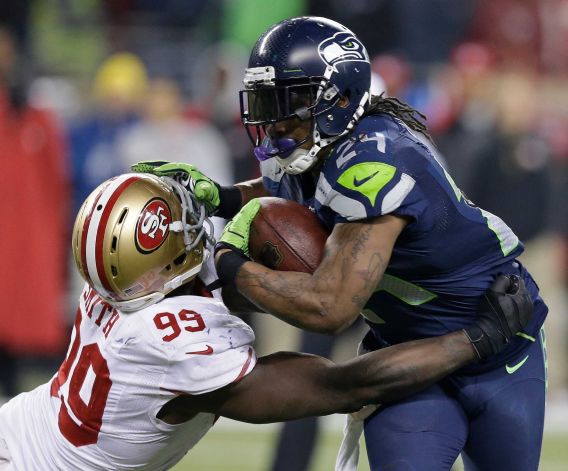
The Seattle Seahawks defeated the San Francisco Giants in the NFC Championship, January 19, 2014
Photo: (Elaine Thompson, AP)

‘Twas a battle in Seattle
But the stars were not aligned
They got crossed so, Niners lost oh
I am sad, and so I rhyme.

At first Colin, he was ballin’
As he launched the quest for six
Then we lost it, when he tossed it
He misthrew and he got picked.

Season’s over, time for closure
There’s just one more task at hand
That’s for Peyton to drive a stake in
To the heart of the 12th man.

My entreaty may seem greedy
But his arrogance abounds
Squash his swagger, teach him manners
Please take Ricky Sherman down

‘Twas a battle in Seattle
But the stars were not aligned
They got crossed so, Niners lost oh
I am sad, and so I rhyme.

Even On Facebook, Silence Can Be Golden

Cartioon of man zipping his lips, with the caption "Zip It!"Social media generally isn’t a place where things happen, at least for my friends and me. It’s a place where we share what has happened, is happening or is about to happen in our lives. We check in at our favorite restaurants and sporting arenas, post photos of kids and cocktails, and circulate links to our blogs.

For some users, Facebook is a platform for spirited debate — but not really in my case. That’s not to say I never share sarcasm or express political opinions. I do, but it’s not to provoke an argument. So if you’re looking to mix it up on social media, just keep on walking.

This week I witnessed a Facebook exchange that started out innocently enough, but went south in a hurry. It got me thinking about how the platform can morph as we expand our list of “friends” to possibly include colleagues (and former colleagues), old classmates, distant relatives, in-laws, and so on. Eventually, our posts can land in the news feeds of both close friends and distant acquaintances who have never met – with some unfortunate consequences.

My high school friend I’ll call “S” shared a bittersweet story about her daughter, who is around 6 years old and as smart as a whip.  The little girl missed out on her desired role in a school production of “Frozen”, in part thanks to the class bully. I don’t have particulars about how it all went down backstage, but according to S the bully followed up by calling her daughter a lesbian.  Her daughter replied, “I don’t think that’s a bad word, but I am not a lesbian, I don’t think, because I think I like [male classmate].”  Wasn’t that a great answer?  Didn’t I say she was smart?

It hurts to see your child profoundly disappointed and bullied, so S turned to Facebook, where her friends offered words of encouragement and praise for her daughter. A few even took shots at the bully, who was not named (and neither was the school).  It’s safe to say S is not Facebook friends with the bully’s parents, so it was all pretty tame and low risk…until someone on the string called the bully the b-word. That’s when the s-word hit the fan.

I’m not big on name calling; even if I’m fuming I usually stick with “jerk”. Still, I was shocked when one of S’s Facebook friends became outraged and let the commenter HAVE IT. She was patronizing and judgmental, which only encouraged more Go-Team comments from the crowd.

S explained in a private message that these squabbling “friends” had never met, so the indignant one didn’t realize that the name-caller is gay, and perhaps extra sensitive to terms like “lesbian” being hurled like rocks by schoolyard bullies.

If S had met friends for happy hour and shared her story, someone would probably have criticized the bully and her parents, and perhaps even called the kid a name. If the outraged Facebook friend had been in attendance, would she have brought the hammer down on the conversation? She presumably would have known everyone at the table, so would she have held her tongue or tried to subtly change the subject instead?

Did the nature of Facebook enable her in some way? There was no anonymous handle to hide behind, but her combativeness may have been fueled by geographic distance and the knowledge that there was virtually no chance she’d ever meet the name-caller face to face.

S’s friend argued that Facebook is public, and therefore an inappropriate forum in which to criticize someone else’s child — even if you don’t use his/her name. But is it really public, if your posts are seen by “friends only”?  Is the issue that many of us have been too liberal in how we’ve defined “friend”? 

In social media and on my blog, my motto is: “Don’t post anything you wouldn’t want your mom or boss to read.” That doesn’t mean they have to AGREE with what I write. What’s more, I don’t feel obligated to moderate comments to my posts to ensure that they are palatable to everyone I’m connected to. If someone did something nuts like use a racial epithet, I’d delete the comment and block them. Otherwise, I assume my friends will keep debate constructive and non-personal. If they just can’t manage that, there’s always the “hide” function.

While I’ve hidden a few “my life is so great, my spouse is so hot, my house is so large” types, I would never dream of chastising them. I accept that others may find them sweet or inspirational; I just find them annoying. No need to make a big fuss about it, though. Relief it just a click or two away. 

Facebook dislike buttonS’s friend was unwilling to just step away from her computer, and the confrontation did not end well for her. The next time she is similarly incensed, maybe she’ll choose to just be still. To paraphrase a line from the Hayden Panettiere song “Boys and Buses”, if you aren’t happy with what you’re seeing on Facebook right now, “just give it ten or fifteen minutes.” By then, the offending remarks will be long gone, replaced by a new set of posts and comments to judge.

If Facebook ever reaches a point where political correctness interferes with the ability to be authentic, in the spirit of “we’re all friends here” (or at least, we’re all civilized adults here)… that’s when I’ll go shopping for a new social media outlet.

stop

Review: “The Good House”… Is Very Good

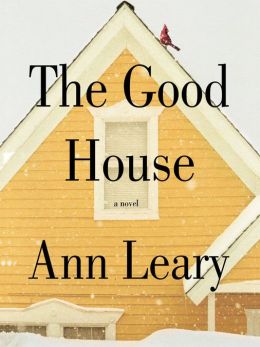
Book jacket for "The Good House" by Ann Leary.Sixty-year-old Hildy Good descends from an accused witch, who was executed during the infamous Salem witch trials. It is a story she tells to clients, when she’s looking for a good local hook. Hildy is the most successful real estate agent – or to hear her tell it, the most successful businesswoman – in her hometown of Wendover, Massachusetts. She is also an alcoholic.

It is customary to preface “alcoholic” with the word “recovering”, but readers of The Good House by Ann Leary will have to dig pretty deep to find any hint of recovery going on with Hildy.

The book begins with Hildy grudgingly attending a cocktail party, and sipping club soda. Since she returned from rehab at Hazelton two years ago, she no longer drinks… in public. It turns out she has stashed cases of wine in her cellar, and the trunk of the MG her ex-husband abandoned in her garage when he left her. Nearly every night, she holds a “party of one”.

The book offers plenty of plot twists-and-turns to engage readers: conflicts between locals and out-of-towners, simmering professional rivalries, family friction and tragedy, extramarital affairs and some late-middle-age nookie. Most of it is funny stuff. (Ann Leary is married to comedian Denis Leary, and is damn witty in her own right.) No character is more engaging than Hildy Good.

Readers spend a lot of time inside Hildy’s head, as she equivocates and justifies her drinking habits in ways that are both eye-roll inducing, and heart breaking. She lays out a set of rules that – as long as she abides by them – prove to her that she’s not an alcoholic. She then proceeds to violate them all, in short order.

“Most nights, I just have a few glasses,” Hildy explains. She then recounts that, after the cocktail party, “by the time I had poured the last of the bottle into my glass, I was fully transformed. I was myself.”  All this, without a hint of irony, or self-awareness.

Hildy is prone to blackouts, something doctors warn her is common in the later stages of alcoholism, but she remains in denial. “Is a blackout really a blackout, if nobody is there to see it? Not even yourself? I say no. It’s like a tree falling in the woods. Who cares?”

She claims she no longer drinks as frequently as she did before Hazelton: “Not every night anymore. Not every night, no.” Yet aside from a brief attempt to go cold turkey after an especially humiliating blackout, when her secret is nearly discovered by one her daughters (whose intervention led to her trip to rehab), each day she is chomping at the bit at 5 p.m. (A Hildy rule: No drinking before 5 o’clock. Starting earlier makes one an alcoholic.)

Hildy vows not to drive or use the telephone after drinking alone. “What a relief to not have to wake up to all that bullshit to undo.”  But it happens throughout the book, when she blacks out. If she recognizes her descent deeper and deeper into addiction, she doesn’t even admit it to herself.

If you’ve ever known an alcoholic, or someone who abuses alcohol, you’ll recognize some of Hildy’s behavior. In the rare cases when she extends her party-of-one to include a friend, she refills her own wineglass surreptitiously, assuming her friend won’t notice. I’ve seen people do this. Initially I assumed they were being clueless or rude, but later realized their goal was to hide how much they drank. (They were not successful.)

Hildy is also proud of her ability to disguise her delicate, morning-after condition by avoiding eye contact and using breath mints – but those who encounter her day-to-day aren’t fooled. And when her friends mention late-night visits and phone calls she can’t remember, she thinks she fakes it well enough to avoid suspicion. (She doesn’t.)

Of course, as Hildy’s secretive drinking becomes less of a secret, there’s bound to be a crisis – a “jackpot” event that she can neither avoid, nor lie her way out of. You pray that THIS is her rock bottom, and that she’ll finally see and accept the truth that she is an alcoholic, in need of professional help.

It’s interesting to note that Ann Leary is herself a recovering alcoholic, so she knows whereof she writes. The rationalizations and distorted truths that bounce around inside Hildy’s head ring authentic. Reviewers raved about the book when it was published back in March, and I hear it is being made into a movie starring Meryl Streep (who else!) and Robert De Niro.

My suggestion: Pour yourself a glass of wine (not two), sometime after 5 p.m., and get to know Hildy and the eccentric residents of Wendover. The Good House is a wicked good story. (Sorry!)

Stand Down, CNN

Howard Beale (Peter Finch)  loses is grip in the 1976 United Artist film "Network".

I can now officially blame 24 hour news for nearly everything that is wrong in this world. It is a sad day when a potential Republican presidential candidate is on the ropes (or nearly so), and I can’t draw enjoyment from it.

Although I was not a fan of Governor Chris Christie from the start, I appreciated his gracious response to President Obama’s support of New Jersey after Hurricane Sandy in 2012. He took flak from the far right for saying something – anything – positive about the President. From my side of the aisle, he showed a lot more integrity than did Republican lawmakers who loudly bashed the American Recovery and Reinvestment Act, while at the same time (and with a lot less publicity) accepting stimulus money for their home states. He openly and without apology put the best interests of the citizens of New Jersey ahead of party, and future political ambitions. It’s what a governor gets paid to do.

I briefly wondered if I could vote for Christie someday, as a way of casting a vote against partisan politics. It wasn’t out of the question; there were times when I might have considered voting for John McCain. (That was long before 2008, in case you were wondering.) But when I evaluate Christie in total…Nah, it’ll never happen.

Governor Chris Christie shouts down a New Jersey teacher on the campaign trail in 2012Chris Christie says he’s not a bully; he’s just a no-nonsense, what-you-see-is-what-you-get kind of guy. Ask a question he doesn’t feel like answering? He’ll tell you it’s none of your business. Question his effectiveness in a certain area?  He’ll holler until he’s red in the face, and wag his finger at you.

I’ll let the people of New Jersey decide if that works for them, but it’s a liability in the national arena. He’s not the guy I want having diplomatic discussions with leaders of unfriendly nations – or with allies, for that matter.

(Have you noticed that every election cycle, a segment of America moons over a straight talker who becomes the early front-runner? He/she eventually crashes and burns, after becoming a little too “refreshing”. Remember Ross Perot? Herman Cain? Sarah Palin?)

Let’s fast forward to this week’s traffic scandal, which is quickly turning a bit Lord of the Flies on cable news. Yesterday, Christie spent two hours denying he had any knowledge of his staff’s ordering lane closures to snarl traffic to the George Washington Bridge in September, as political revenge against Fort Lee’s mayor.

While it is the role of the media to thoroughly investigate the matter, and assess whether actions by members of Christie’s administration reflect the petty, vindictive style of the boss, who may want to run for president in 2016 — it’s a CRAZY FEEDING FRENZY out there!

Some will argue that a liberal media agenda is at work – or maybe a tea party one. Others may think it’s the work of a few ambitious journalists, who want to turn the story into Watergate, and themselves into Woodward or Bernstein (depending on hair color). It may even be driven by how easily the scandal lends itself to pithy headlines: Christie’s In a Jam! 

I blame 24 hour news, and the incessant need for CONTENT.  If you don’t think writers, editors and pundits are licking their collective chops because a story like this — if they can keep stoking suspicion of the Governor’s involvement — could fuel the news cycle for days… well, you probably don’t have a TV at your house. Or access to the internet.

In his new book “Duty: Memoirs of a Secretary at War,” former Secretary of State Robert Gates remembers that Washington lawmakers could be reasonable, right up to the point “the little red light went on atop a television camera [which] had the effect of a full moon on a werewolf.”

We’ve all seen it, and it’s enough to make you shake your head in despair. The fault lies not just with Congress, but also with the news networks that fan the flames, spin the facts, and broadcast on a loop.  And it’s our fault, for giving our tacit approval of the coverage by watching it.

I received a breaking news alert from CNN this morning, letting me know that a batch of documents related to a New Jersey State Assembly investigation of the Governor’s advisors had JUST BEEN RELEASED. CNN assured me they would dig through the document “dump” and post updates online throughout the day.

2:58 p.m. ET – As you can expect, everyone is trying to get these documents at the same time, so download speed is slow. Bear with us.

Breathe easy, America.  CNN is on the job.

Living Velveeta Loca

Velveeta Print Ad: Eat Liquid Goal

If you’ve noticed your cupboard is lacking
A popular processed cheese spread
That smothers your nachos
And squirts out of tacos
And melts between slices of bread.

It’s more than a terrible rumor
The facts have been widely reported
From Maine to Topeka
Someone’s moved our Velveeta
We’re facing a national shortage.

Turns out there’s a good explanation
For how things have gone so awry
It’s not just neurosis
Here’s the diagnosis
Demand is exceeding supply.

You can’t find a block of it anywhere
Not a sliver, a chunk or a slice
We won’t go organic
We’ve started to panic
So desperate, we’ll pay any price.

If you’re hosting a Super Bowl party
And the lack of Velveeta displeases
Just blame it on Kraft
And pour lots of drafts
To distract from the crackers and Cheez Whiz.

Mel Ramos poster of Velvetta package
Artist: Mel Ramos, American (1935 – )

High Times

TV's Judge Judy wags her finger in a tsk tsk motio
Tsk Tsk!

A CNN/ORC International survey released today suggests that a majority of Americans (55%) support legalizing pot, while only 44% oppose it. This follows a New York Times report on Sunday, indicating that Governor Andrew Cuomo is set to legalize medical marijuana in his state. Oh, and unless you’ve been living under a rock somewhere without 24-hour cable news, you are probably aware that on January 1 Colorado became the first state to fully legalize recreational marijuana for residents 21 and older.

So, what’s the verdict?  Is it high time, or does legalized pot stink to high heaven?  (Ha, see what I did there?)  According to erudite New York Times columnist David Brooks, these changes will have sobering consequences. (There, I did it again!)

In his January 2 op-ed, Brooks sought to walk the fine line between 60’s freethinking bohemian and dowdy prig.  He reminisced about smoking pot as a teenager, and the embarrassing things he and his friends got up to. There was something about going to honors English high and COMPLETELY bungling his recitation of Chaucer in Middle English. I mean, can you imagine? The HORROR! A cautionary tale, boys and girls, if ever I did hear one.

OK, I’ve long had a teeny crush on Mr. Brooks (or David, as I like to call him) so I feel a smidge guilty for lampooning him, and embroidering his story for my own blogging gain. But when he moralizes that government should encourage “the highest pleasures, like enjoying the arts or being in nature” over smoking weed… He couldn’t possibly mean OUR government, could he? The 113th do-nothing Congress? David Brooks was born in Canada, which may account for his unfounded optimism. Or else, he’s smoking something.

I make light of this subject because the truth is, I don’t take it very seriously. I feel much more passionately about marriage equality, and I’m straight!

Every argument for criminalized marijuana I’ve ever heard could also logically be applied to alcohol. “Smoking and driving is a good way to get yourself killed,” writes Brooks. True, but so is drinking and driving – and texting and driving, for that matter. Both are illegal, and still prevalent.

“Young people who smoke go on to suffer I.Q. loss and perform worse on other cognitive tests.”  Granted, I’m not a doctor, but I suspect teens who abuse alcohol suffer the same effects.  Plus, no one is proposing legalizing pot for teenagers.

No, I don’t worry that society will go to hell in a handbasket if recreational pot is legalized. I don’t predict that unemployed stoner zombies will roam the streets, bloated from gorging on Fritos bought with food stamps. Once the media turns its collective attention to some other chicken little-type story, and the novelty has worn off, I think usage will normalize. People who smoked pot before will continue to do so, probably in similar quantities — and unless a pot dispensary sets up shop in their lobby, pretty much everyone else will just drink wine. (Wine has a nice “nose”. Pot stinks like a skunk — which I can prove, because my downstairs neighbor is a stoner and his smoke permeates everything. It’s an olfactory offense.)

One thing David Brooks and I agree on: We’re too old to party like rock stars. That may be because we’ve matured, or maybe it’s just because we have work in the morning. Either way, no law change or ballot initiative will reverse it.

And do you know what? I wouldn’t want it to.

Put that in your pipe, and smoke it.

Don’t Forget To Write

Black and white photo of hands typing quickly
Photo: aless&ro

It’s a new year, and I’ve accepted a new challenge. It’s not related to a weight loss or workout resolution, or even a public declaration to overhaul my spending. Rather, I have taken up the gauntlet thrown down by WordPress.com (which hosts In Write Field) to embark on a “Zero to Hero: 30 Days to a Better Blog” challenge. I’ll receive one blog topic per day, which I can choose to avail myself of… or not. Truth be told, I don’t have the time, stamina or imagination to blog every day, but I figure I can pick and choose.

The challenge seems geared more toward brand new bloggers, who don’t know where to start – whereas I’ve been blogging fairly regularly for nearly two years. Still, I frequently struggle to find something to blog about. “Topics,” I’ll beseech my friends. “I need topics!”

Articles and books for aspiring writers often advise that one needs to just “start writing”, and not worry about the topic. That’s easy to say, for someone who doesn’t have a goal of at least three blog posts per week. Yet, I agree that it is possible to over think when searching for blogging subject matter.  When a topic is timely, I sometimes find it’s already old news by the time I’m ready to publish my point of view.

So, off I go…

Today’s Zero to Hero topic: A self-introduction. Why do I blog instead of, for example, keep a journal? What do I want to accomplish with my blog? What do I like to write about?

The first part is easy. I love writing – always have. Professional opportunities for me to write, with an emphasis placed on selecting just the right tone and phrasing, and engaging an audience, feel like work only in the loosest sense. And, as some of you may have noticed, I love to tell a story with words – and images. To me, this kind of writing requires an audience. Telling stories in a journal would be like trees falling in the forest; who cares, if no one but me hears them?

The other questions are trickier. While some bloggers zero in on a specific subject, I started out a generalist – just to get a feel – and have yet to find a niche. I’m not even sure if I want one. While I write a lot about America’s pastime in the summer and early fall, even a rabid fan like me can’t be all baseball, all the time. Perhaps this approach has made it more difficult to build a following?

I recently blogged about some of the challenges of being a single woman of a certain age, and (by my standards) it really took off. I even got a “high-five” alert from WordPress as views and visitors spiked. Engagement was surprising, because it ran the gamut – men, women, single, married.

I’m not entirely sure why the post resonated more than others I’ve written. A friend suggested that I’d really owned the topic, and that’s why it struck a chord. If so, that’s great. When it makes sense, I’ll blog again about single life – but I don’t want to be the next Carrie Bradshaw.

“And so I asked myself… how does a girl know when he’s just not that into her?”

Thus, my Zero to Hero adventure is underway. I’ll take some chances blogging about topics I normally wouldn’t choose, and see where it takes me.

Hope you’ll come along for the ride.

New Year’s Goals Are Nice, So I Made Them Thrice…

Four champagne glasses etched with 2,0,1,3 for New Year's Eve 2013

There was a time when I partied every New Year’s Eve, like it was 1999.  Living in New York City after college, I’d buy a new dress, splurge on an overpriced prix fixe meal with friends, drink bad champagne and wake up with a fistful of ATM receipts I couldn’t explain, a hangover, and a lingering disappointment because the previous night hadn’t met my overblown expectations.

Ironically, by the time December 31, 1999 actually rolled around, I had moved to California and abandoned such revelries in favor of a quiet night in – and I’ve never looked back.

I used to worry I was a nerdy recluse for boycotting most New Years’ Eves, but now most of my 40-something contemporaries have also embraced ringing in the new year like a bunch of almost-Amish. Today my Facebook news feed was dominated by friends’ predictions that they would be sound asleep before the ball dropped. It’s as if my entire Facebook network is scheduled to milk cows at daybreak.

My forbearance doesn’t mean I lack New Year’s Eve traditions, though. I always kick things off with the practical; I take down my Christmas tree and drag it to the curb, so that San Francisco can mulch it for some eco-friendly use. I then spend several hours cleaning up pine needles (this will continue until at least March) and washing tree sap off my hands.

Next, it’s time for the aspirational; I jot down my resolutions. Well, not really resolutions – just goals for the year. I’m not much of a planner. I’ve traditionally been more of a fly-by-the-seat-of-my-pants girl. But it’s important to have goals, and I usually set one each related to health, career and personal/social.

To make sure my New Year’s goals are at least somewhat attainable, I also map out high-level steps to reach each one. So if I aim to read more for fun, as I did several years ago, I may target reading two books per month, plus the Sunday New York Times each week.

This year, I’m delighted to NOT count stepping up my job search among my goals. For the first time in years, there is no need to overhaul my resume (did it in the fall), rewrite my LinkedIn profile (ditto) or submit X job applications per week. I’m only just entering my third month in a job I’m very excited about, so I still have plenty to learn by staying put. That said, I’ll need a goal around professional networking, which is a year-round necessity these days. Otherwise I won’t do it, because I enjoy networking about as much as I enjoy breaking large rocks in the hot sun, with a small hammer.

For better health, I’ll try a new tack in 2014. Instead of setting a goal to lose a specific amount of weight, I will continue my strict no-carb regimen until June. (I’ve been following it on-and-off since May, and the results when I’m disciplined have been impressive.) I will put forth 100% effort, but won’t focus on a number. Whatever I weigh in June… I will work to maintain afterwards. Done.

In other words, in 2014 I hope to make peace with myself, so that my 2015 health goal can be completely unrelated to dress size. Now, that would be bliss!

Personally?  I’m still mulling that one. My sports photography class kicks off in a few weeks. Once that’s done maybe I’ll find a book club? Or a volunteer gig? Thankfully, there’s no LAW that says I must decide by midnight. Perhaps I’ll just set a goal today… to choose a goal by March.

Oh, and blogging! I nearly forgot about a blogging goal!  Friends, you’ll hopefully be hearing more from me in the new year. Ideally three times per week, if I’m being precise.

Ready?  Set?  RELEASE THE HOUNDS!

And, Happy New Year!

Fireworks as London rings in 2013.
Photo: London Times